Arcadia Science is heading to #TAGC24.

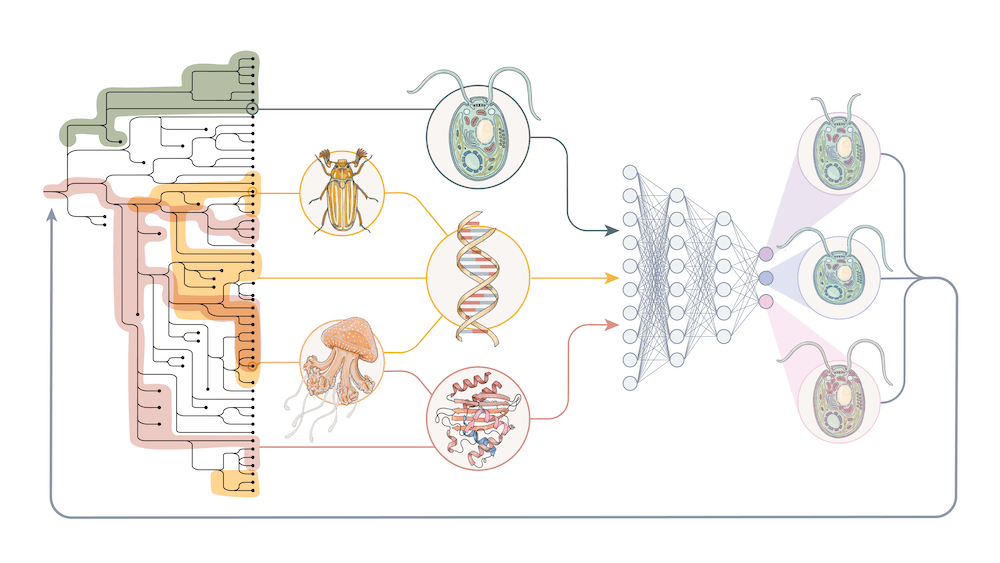
By unifying various genetic approaches, we can identify more human-relevant and research-friendly models, develop new hypotheses, decode genomic function, and more. Join us at TAGC24 to hear about our approach to integrating genetics as we predict drivers of biological innovation across evolutionary scales.

On this page, you can see what we'll be up to, when/where you can find us, and check out all the science we're sharing, including poster PDFs and links to full pubs.
Arcadia is heading to #TAGC24.

Featured events

Poster
Thu Mar 7, 12.45-1.45pm
Riverview A
Lunch: Community, connections, and mentorship
Poster
Thu Mar 7, 7.30-10.00pm
#P961
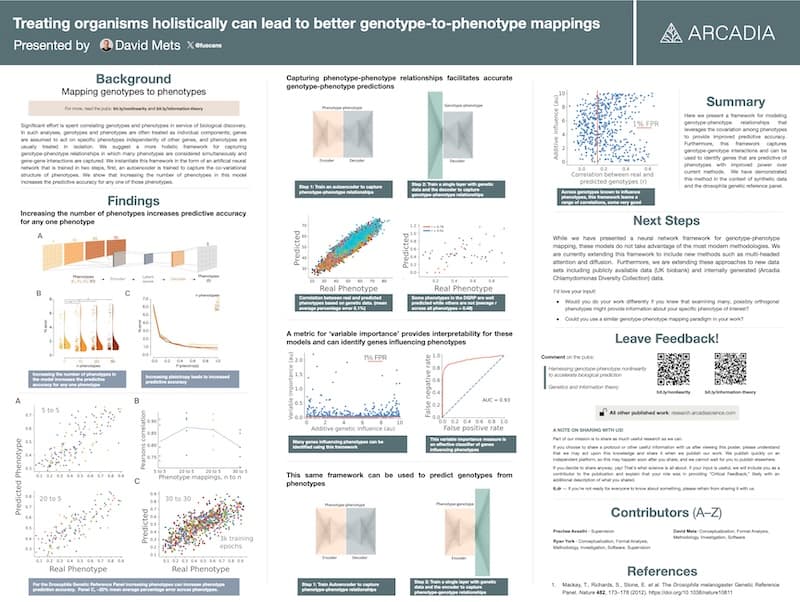
Poster: Treating organisms holistically can lead to better genotype-to-phenotype mappings
Poster
Fri Mar 8, 8.30-9.00am
Maryland D
Panel: Arcadia's high-level approach to genetics (Session: Genetics in drug discovery industry)
Poster
Fri Mar 8, 11.30-11.45am
Woodrow Wilson BD
Talk: ProteinCartography - Comparing proteins with structure-based maps for interactive exploration
Poster
Fri Mar 8, 8.30-10.30pm
#P969
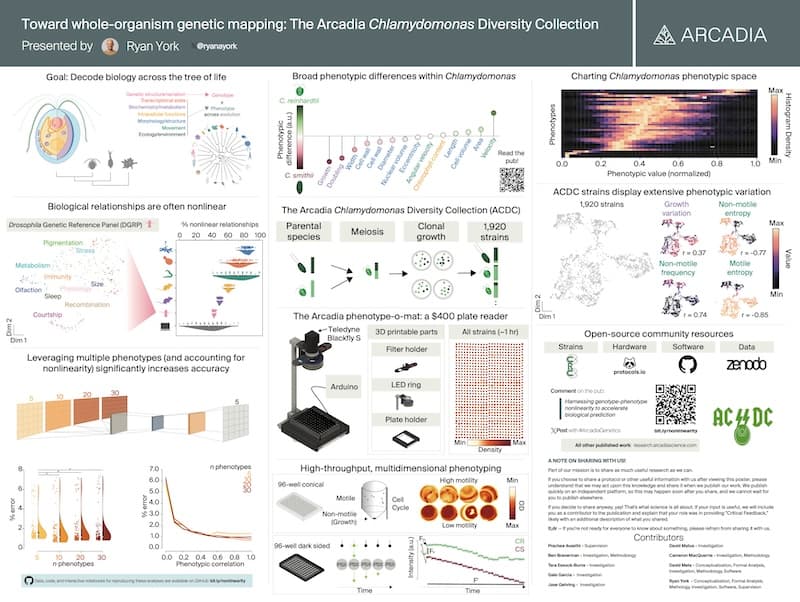
Poster: Enabling integrative cell biology with the Arcadia Chlamydomonas Diversity Collection
Poster
Sat Mar 9, 8.00-10.00pm
#P921
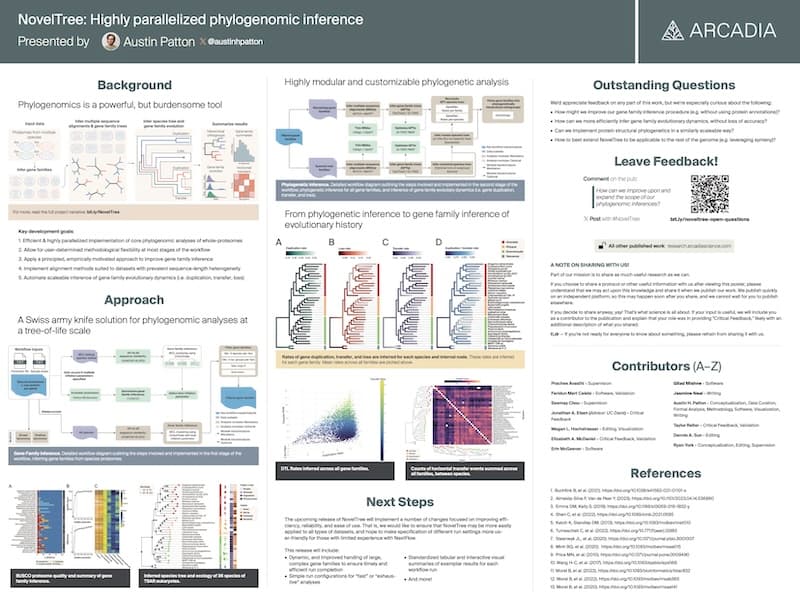
Poster: NovelTree: Highly parallelized phlyogenomic inference

Featured pubs

Open question
Mar 05, 2024
How can we improve upon and expand the scope of our phylogenomic inferences?
We're seeking feedback on NovelTree, our modular phylogenomic workflow. We'd appreciate your insights into how we can improve gene family inference, incorporate protein structure predictions, and expand to whole-genome data as input.
Resource
Sep 28, 2023
ProteinCartography: Comparing proteins with structure-based maps for interactive exploration
The ProteinCartography pipeline identifies proteins related to a query protein using sequence- and structure-based searches, compares all protein structures, and creates a navigable map that can be used to look at protein relationships and make hypotheses about function.
Resource
Sep 28, 2023
NovelTree: Highly parallelized phylogenomic inference
We want to find and use evolutionary innovations to solve present-day problems. We developed NovelTree, an efficient phylogenomic workflow that will empower us to decode the evolutionary traces of these innovations across the tree of life.
Perspective
Sep 27, 2023
Applying information theory to genetics can better explain biological phenomena
Genetic models of complex traits often rely on incorrect assumptions that drivers of trait variation are additive and independent. An information theoretic framework for analyzing trait variation can better capture phenomena like allelic dominance and gene-gene interaction.
Result
Sep 22, 2023
Harnessing genotype-phenotype nonlinearity to accelerate biological prediction
It is commonly assumed that phenotypes arise from the cumulative effects of many independent genes. However, we show that by accounting for dependent and nonlinear biological relationships, we can generate models that predict phenotypes with great accuracy.

Learn about ProteinCartography

The ProteinCartography pipeline identifies proteins related to a query protein using sequence- and structure-based searches, compares all protein structures, and creates a navigable map that can be used to look at protein relationships and make hypotheses about function.

Try ProteinCartography

ProteinCartography case studies

Result
Feb 14, 2024
Exploring the actin family: A case study for ProteinCartography
We've applied ProteinCartography, a tool for protein family exploration, to the well-studied actin family. We're able to categorize actins and related proteins into distinguishable functional buckets, and we uncovered some surprising hypotheses that could prompt further study.
Result
Oct 6, 2023
Discovering shared protein structure signatures connected to polyphosphate accumulation in diverse bacteria
Only some bacteria accumulate substantial amounts of polyphosphate (polyP). We thought that despite sequence divergence, polyP synthesis enzymes in these bacteria might have similar structures. We found this is sometimes true but doesn't fully explain the phenomenon.

Join our community